
Black Friday is not prepared the week before. The most structuring constraint is not commercial but regulatory, and it kicks in thirty days before the operation. A store discovering this point in mid-November has already lost the ability to display the discounts it had planned.
Here is a six-week countdown plan, starting with the most binding constraint.
W-6: lock the reference price
The rule from the Omnibus Directive requires displaying, next to the promotional price, the lowest price applied over the previous thirty days. This is not your usual catalog price, it is the lowest price actually applied.
The practical consequence is simple and often discovered too late: any promotion, flash sale or discount code applied in the thirty days preceding Black Friday mechanically lowers your reference price, and therefore reduces the discount you will be able to announce.
Six weeks out, two actions. Draw up the list of references that will go on promotion, and freeze their price over the preceding thirty days. Then extract the price history applied to those references, to know the real reference price you will have to display.
If your store runs one promotional operation after another, this audit often reveals that the announceable discount is well below the one you had in mind.
W-5: build the promotion plan
Three decisions, in this order.
The selection. Neither the whole catalog, nor three references. A selection of 10 to 20% of the catalog, chosen on two criteria: available margin and pulling power, meaning the products that bring in a cart to which non-discounted items get added.
The mechanic. Percentage discount, bundle, gift, or cart threshold. The percentage discount is the most readable and the most expensive. Bundle mechanics preserve margin better at equivalent perception.
The depth. Calculate the margin after discount, shipping costs included, and check that it stays positive on the expected average cart, not on the ideal cart.
W-4: stock and logistics
Two questions that decide the rest.
Does available stock on the promoted references cover expected demand, generally two to four times a normal volume on the highlighted products? A stockout on the day turns a successful operation into a wave of complaints.
Does your fulfilment chain absorb the peak? Orders from the Black Friday weekend ship the following week. Plan for reinforcements, warn the carrier, and above all announce realistic rather than optimistic lead times. A lead time announced at three days and met in eight costs more in customer service than the margin gained.
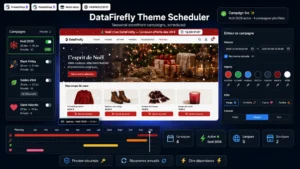 Scheduled Seasonal Decorations – Christmas, Black Friday & SalesYour store dresses up for Christmas on its own€99.00
W-3: the visual dressing
The visible part, and the one that should be prepared in advance rather than cobbled together the night before.
Announcement banner, category visuals, dedicated operation page, badges on product pages. The important point is scheduling: these elements must activate and deactivate automatically on date, without a manual intervention on a Sunday evening.
Plan for the end too. A site still dressed in Black Friday colours on 15 December gives the impression of an abandoned store.
W-2: the technical side
Four checks, to be done before the traffic arrives.
- The load test. Simulate five to ten times your normal traffic and observe where it breaks. It is almost always the database, on filter and search queries.
- The cache. Check that product and category pages are indeed served from cache, and plan the purge at the moment of the price change.
- The fallback plan. What do you do if the site goes down on Friday at 10 am? A holding page with email collection is better than a server error.
- Backups. A full backup just before the operation, and verified. A backup never restored is not a backup.
W-1: the emails
Three sends are enough: an announcement at D-3, a launch on the day, an ending reminder. The ending reminder usually generates more orders than the announcement.
Also open a waiting list on the products that will go on promotion, for visitors arriving before the launch. It is the best possible sending base: it contains people who have already expressed a precise interest.
D-1: the checklist
Promotional prices are scheduled with a start date and an end date. The displayed reference price is correct. Stock is up to date. Emails are scheduled. The banner is scheduled. A test order has been placed end to end, payment included. The fallback plan is accessible.
The day after
Exiting the operation matters as much as entering it. Prices revert automatically, badges disappear, the dressing is removed. And you record three figures while they are fresh: revenue by mechanic, real margin after discount and shipping, and the return rate on products bought on promotion, which is generally higher than normal.
The Scheduled Seasonal Decoration module handles the dressing part on PrestaShop 8 and 9: banners, visuals and decorative elements scheduled with a start and end date, with automatic return to the normal state. For the discount mechanic itself, the Flash Sale and Countdown module manages the periods and the automatic ending.