
Trust blocks are everywhere, and most of them serve no purpose. A row of six pictograms in the footer, identical on every store, that nobody reads. The problem is not the principle, it is the application: these blocks answer questions the visitor is not asking, at a moment when they are no longer asking them.
The three real questions
A visitor hesitating in front of a buy button asks themselves three questions, in this order.
Will I receive it, and when? It is the first worry, and it concerns the delay as much as the reliability.
What if it is not right? Return, exchange, warranty. This question grows with the price and with the uncertainty about the product.
Is my payment safe? Contrary to what people believe, it is the least frequent on a professional-looking store. It becomes central on an unknown or badly finished site.
A trust block that answers none of these three questions is a decorative element.
What reassures changes with the average order value
This is the point generic lists ignore.
Below 50 euros, the dominant concern is the cost and the delivery time. Shipping costs and the estimated arrival date are worth all the security badges in the world. The financial risk is low, the customer does not worry about the warranty.
Between 50 and 300 euros, the return becomes central. The customer wonders what happens if the product does not fit, how much it will cost them, and how long they have to decide. It is the bracket where a clear return policy produces the most effect.
Above 300 euros, the worry shifts to after-sales and the human side. Is there a reachable customer service? What happens if the product breaks down in eight months? Instalment payment also enters the reassurance field at this price level.
A store with a 35-euro average order value has no interest in prominently displaying a “2-year warranty” block, and a store with an 800-euro average order value wastes its time with “delivery in 48 h”.
 Trust Badges & Reassurance BlocksReassure your visitors, convert more€59.00
The position
Below the buy button, within the visual field of the price. Not in the footer, where the blocks are seen by a minority of visitors, and never at the moment of decision.
Three to four elements, not six. Each additional element dilutes the attention given to the others, and a dense row ends up looking like a decorative banner the eye skips.
On mobile, the block must remain visible without additional scrolling after the button. If the theme sends it lower, two well-placed elements are better than four out of view.
The wordings that do not work
“100% secure payment”. An empty phrase, present on every site, including fraudulent ones. It carries no information. Naming the accepted payment methods, with the real logos, does more.
“Satisfaction or your money back”. Too vague to reassure. “Free returns within 30 days” gives the two missing pieces of information: the cost and the timeframe.
“Fast delivery”. Fast means nothing. “Ships today if ordered before 3 pm” is verifiable and actionable.
“Customer service at your disposal”. Replace it with the hours and the channel. “By phone Monday to Friday, 9 am to 6 pm” beats a promise of attentiveness.
The common rule: effective reassurance contains a number or a precise modality. If your competitor can write exactly the same sentence, it does not distinguish you.
What not to put
Bank card logos as proof of security. They indicate the accepted methods, not a level of protection, and piling them up looks makeshift.
Certifications you have not obtained. An imitated or generic trust badge gets spotted, and it produces the opposite of the intended effect.
Mentions redundant with the rest of the page. If the delivery time is already displayed under the price, do not repeat it in the block.
Consistency with reality
Reassurance only holds if it is true. Announcing free returns within 30 days then charging the return shipping produces a dispute, a negative review, and a loss of trust that far exceeds the initial conversion gain.
Before writing a block, check that your terms and conditions say the same thing, and that your customer service actually applies the rule. All three must match.
Measuring
The overall conversion rate will barely move and will tell you nothing. Two more useful measures.
The click rate on the blocks, when they link to a detailed page. A never-clicked block is not necessarily useless, but a heavily clicked block signals an important question badly addressed elsewhere on the page.
The volume of customer service questions on the topics covered. If requests about delivery times drop after adding a block, it is working, even if the conversion has not visibly moved.
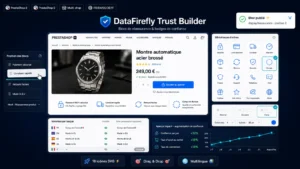
The Trust Blocks and Trust Badges module handles these elements on PrestaShop 8 and 9: blocks configurable per product or per category, positioning below the buy button, adapted mobile display and text customisation without modifying the theme.