PrestaShop Catalogue Management

Prescription Glasses Module for PrestaShop: Rx Entry and Lens Selection

Customers enter their prescription, choose their lenses and know straight away whether the frame can take them.

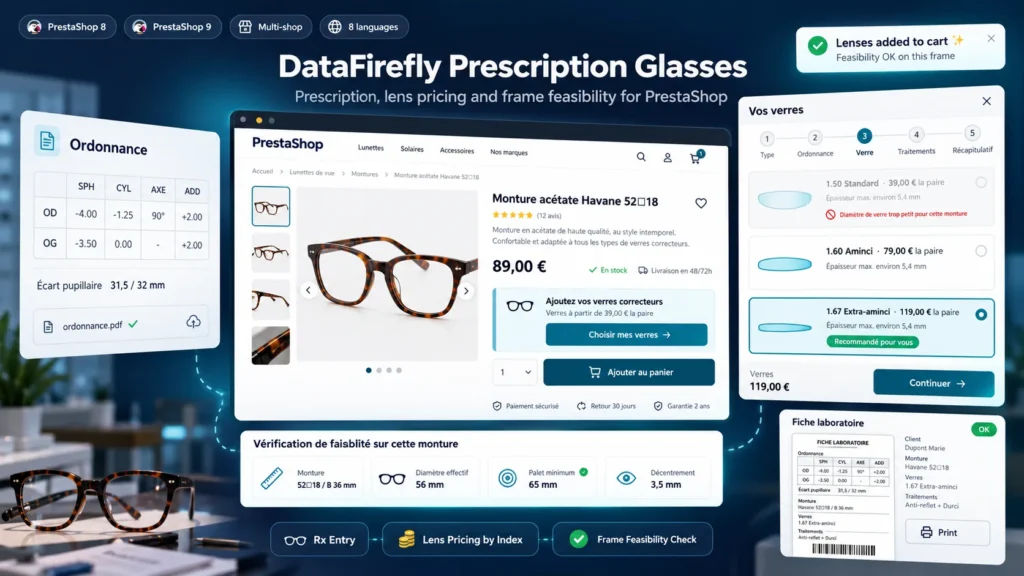
Selling prescription glasses online runs into three questions: how to collect a prescription without mistakes, how to price lenses whose cost depends on the index and treatments, and how to avoid selling a correction that cannot be fitted. This module adds a five-step flow to the page of every frame: lens type, prescription, lens, treatments, summary. The server checks every value, lenses that do not suit the correction or the frame are set aside with the reason, the thickness of each lens is estimated and drawn to scale, and the price is added to the cart line. The optician finds the full prescription in the order, with the centring already calculated and a lab sheet to print.

At a glance
  • Prescription entry: sphere, cylinder, axis, addition, pupillary distance as one or two values
  • Lens price by index, lens type and treatments, added to the cart line and the invoice
  • Feasibility check on the frame: height, power, blank diameter, drilling
  • Estimated thickness of each lens drawn to scale, with a recommended lens
  • Printable lab sheet and a My prescriptions page in the customer account
PrestaShop 8 & 9 Validated prescription Frame feasibility 8 languages
  • 30-day refund
  • 12 months updates
  • 24h support
www.datafirefly.com/en/
Prescription Glasses Module for PrestaShop: Rx Entry and Lens Selection
v1.1.0 · updated 2026-09-24
What it does

The short version.

01

A prescription entered as it is written

Customers copy their prescription into an OD / OS grid: sphere and cylinder from -20 to +20 in 0.25 steps, axis from 0 to 180, addition for progressive lenses, pupillary distance as one value or per eye. The axis is greyed out when the cylinder is 0. The server checks every field and shows the error under the right box. The cylinder is transposed to your lab's convention when saved.

02

The right lens, with the reason

For each index (1.50, 1.59 polycarbonate, 1.60, 1.67, 1.74 supplied), the module checks the sphere and cylinder range, the blank diameter needed for the frame and the pupillary distance, and drilling for rimless frames. A lens that cannot be made stays visible, greyed out, with the reason: Lens diameter too small for this frame and your pupillary distance (68 mm needed, 65 mm available).

03

Thickness shown, not just stated

Each lens card shows the cross-section of the edged lens at the same scale for every index, with the estimated maximum thickness. The recommended lens is the cheapest one under the target thickness, otherwise the cheapest within 0.5 mm of the thinnest: the customer sees why a 1.67 is worth its price, and nobody pushes a 1.74 they do not need.

04

Feasibility on the chosen frame

Each frame carries its A, B, DBL and ED measurements. A progressive lens on a frame that is too shallow is refused, a short corridor is flagged, and a correction above the power the frame accepts is blocked. Anisometropia, strong decentration, high plus power on a semi-rimless frame and an old prescription give a warning. You choose whether to block or to accept with a warning.

05

The right price down to the invoice

Lens and treatment prices go through PrestaShop's native customization: they are added to the frame price in the cart, the order and the invoice, with the correct VAT. When the frame has a percentage discount, PrestaShop applies it to the lenses too: the module shows it with a struck-through price, and the total displayed matches the cart.

06

Everything the workshop needs

The back office order shows the prescription, lens, treatments, frame measurements, decentration and minimum blank per eye, feasibility notes and the prescription file to download. The A4 lab sheet prints in one click, with boxes for checking, edging and final inspection.

The long version

Everything you'd want to know before you install.

A detailed look at how Prescription Glasses Module for PrestaShop: Rx Entry and Lens Selection works, why we built it the way we did, and the thinking behind the features above.

§ 01

Selling prescription glasses on PrestaShop

PrestaShop can sell a frame, not prescription lenses. Optical shops work around it with a customization text field, combinations such as 1.60 lenses + anti-reflective that keep multiplying, or an e-mail requested after the order. The result: prescriptions copied wrongly, lens prices that are wrong as soon as an option changes, and orders that cannot be fitted, discovered in the workshop. This module handles the prescription, the price and the feasibility as one flow checked by the server.

§ 02

What customers see on the frame page

Below the cart button, an Add your prescription lenses block shows the starting lens price and the frame size. It opens a five-step side panel. Customers choose single vision, progressive or no correction, copy their prescription, then see the available lenses with their price, estimated thickness and a recommended lens. They add treatments and finish with a summary: prescription, lenses, feasibility notes, lens price, frame price and total. One click adds the frame and lenses to the cart.

§ 03

How feasibility is checked

The module works on the minus cylinder form, like lens manufacturers. It compares sphere and cylinder with the range of each index, calculates for each eye the decentration between the pupillary distance and the frame centre (A + DBL), then the minimum blank diameter: ED plus twice the decentration plus the edging allowance. A lens whose blank is too small is set aside. For progressive lenses, the frame height B is compared with the minimum height you set. Thickness is estimated with the sag formula, using the centre thickness of minus lenses and the edge thickness of plus lenses you set. These are estimates to guide the choice, not the lab calculation.

§ 04

For the shop and the workshop

Lenses and treatments are managed in Sell > Optics. Frame measurements are entered per product or per combination, from the Modules tab of the product page or by CSV import. Each order shows the prescription transposed to your convention, the calculated centring and the feasibility notes, and the lab sheet prints in A4. Orders flagged to check (unknown pupillary distance, strong anisometropia) stand out in the prescription list. Prescriptions are health data: files are stored outside the public folder, prescriptions of abandoned carts are deleted after the delay you set, and export and deletion go through the official GDPR module.