
A product FAQ serves two distinct purposes: answering the questions that block a purchase, and occupying an extra spot in search results. The second has changed considerably in recent years, and you need to factor that in before investing time in it.
What rich results have become
A point to clarify from the start, because much of the content online describes an outdated situation.
Google has heavily restricted the display of questions and answers in its results. This type of enrichment is now reserved for a limited number of sites, mainly recognised government and medical sources.
Direct consequence: do not build your FAQ to obtain a rich result. The probability is low and it does not depend on the quality of your markup.
That does not make the markup useless. It still helps engines understand the structure of your page, and it feeds the conversational answer systems that are taking a growing place in search journeys.
The right reason to build a product FAQ therefore remains the first one: answering your customers’ questions. SEO is a secondary benefit.
Where good questions come from
This is what separates a useful FAQ from filler.
Four sources, in decreasing order of quality.
Your customer service exchanges. The questions actually asked, in the customers’ own words. Extract them by product category over three months and rank them by frequency.
Your return reasons. A product frequently returned for “does not match the description” tells you exactly which question was left unanswered.
Your internal searches with no results that relate to characteristics: compatibility, dimensions, material. They reveal expectations your content does not cover.
Buyer questions on the marketplaces where you sell, or on those of your competitors for comparable products.
What not to do: invent rhetorical questions. “Why choose this product?” is not a customer question, it is a sales pitch in disguise. It is spotted immediately and it devalues the whole block.
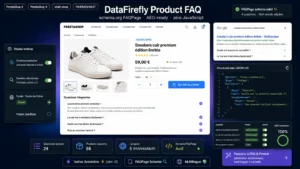 Product FAQ — Static AccordionFAQ accordion on your product pages: manual entry, FAQPage markup, zero JavaScript.€0.00
Writing the question
Three rules.
Phrase it the way the customer speaks. “Is it dishwasher safe?” rather than “Machine washing compatibility”. Natural phrasing also matches the way searches are typed.
One question covers one point. A double question gets a confused answer.
The question must be closed or specific. “How do I use it?” is too broad for a short answer. “Do I need an adapter to use it outdoors?” calls for a clear answer.
Writing the answer
Four principles.
The answer starts with the answer. Yes, no, or the main fact, in the first words. Explanations come next. That is what makes the FAQ scannable, and it is also what automated answer systems exploit.
Two to four sentences. Beyond that, the information does not belong in a FAQ but in the description.
Be precise rather than reassuring. “Yes, up to 60 degrees” is better than “Yes, no problem”.
Own the negative answers. A FAQ that only contains favourable answers is not credible. Saying a product is not compatible with a given use avoids a return and builds trust.
How many questions
Three to six per product. Below three, the block does not justify its existence. Beyond six, you probably have a product description problem: the missing information should live there rather than being handled as questions.
On a large catalog, writing six questions per product is unrealistic. Two workable approaches.
The category FAQ, shared by all products in a family. It handles the common questions: care, warranty, shipping, general compatibilities.
The per-product FAQ, reserved for your main references, the ones that drive revenue and generate requests.
Combining the two is the realistic setup: a category-level base, enriched on the products that deserve it.
The markup, done properly
Five technical rules, three of which determine validity.
The marked-up content must be visible on the page. Marking up questions the visitor cannot see is grounds for a manual action, and it is the most common violation.
One declaration per page. If your theme and a module each produce one, you end up with two competing declarations.
The markup covers complete questions and answers. A question without a written answer, or an answer that is just a link, does not meet the definition.
Do not mark up customer questions with multiple answers as a FAQ. That is a distinct content type, with its own definition, and confusing the two invalidates the declaration.
Collapsed content remains eligible, provided it is present in the served HTML. An accordion works perfectly, click-triggered loading does not.
Where to place the block
The bottom of the product page, after the description and before the reviews, is the most common placement and it works well.
Two justified exceptions. On a technical product, compatibility questions are worth moving up just below the buy block, because they condition the decision. And on a product with strong size uncertainty, the sizing question belongs in the selector, not in the FAQ.
Format: an accordion with the first question open. It shows the type of content without imposing a long expanded list.
The FAQ as a cost reduction tool
The most measurable benefit, and the least tracked.
Every question handled in the FAQ is a customer service request avoided. On a reference generating twenty requests a month on the same point, one well-written question removes most of that volume.
The tracking method is simple: record the number of requests per topic before adding the FAQ, then one month after. The gap directly quantifies the return.
This tracking has a useful side effect: it tells you which questions to add next, since the remaining requests cover what you have not yet handled.
Measuring
Three indicators.
The open rate per question, on a collapsed format. A question that is never opened is badly phrased or of no interest.
The volume of customer service requests per topic, mentioned above.
The return rate of equipped products, compared with non-equipped ones in the same category. On products where the FAQ covers compatibilities or dimensions, the effect is usually visible.
The Product FAQ module for PrestaShop handles this block on PrestaShop 8 and 9: per-product or category-inherited questions, accordion display with content present in the HTML, and structured data markup as a single declaration.